

Currently Empty: $0.00
Sales
Inside the Room: Why This Wasn’t Just Another Government Sales Workshop
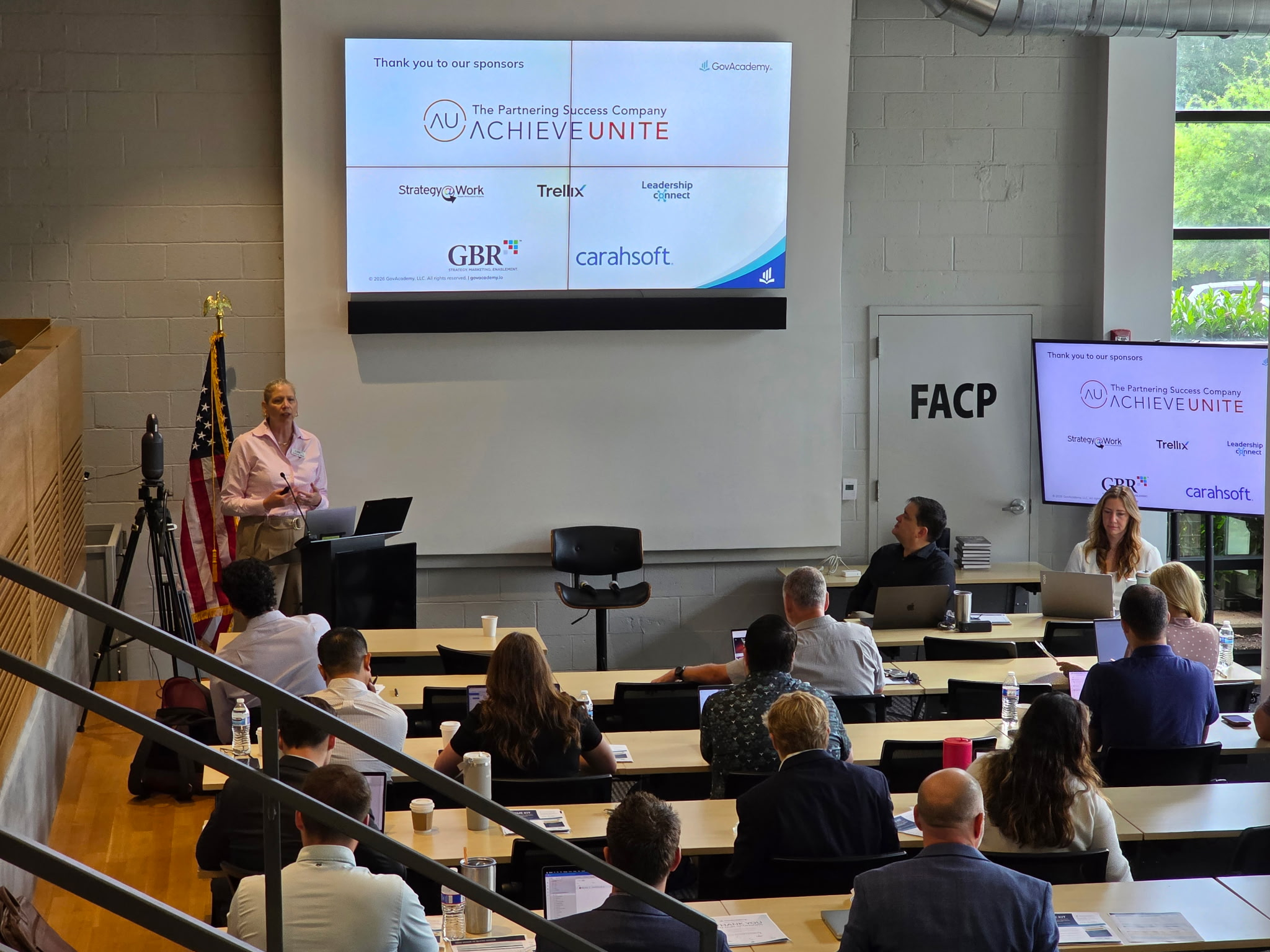
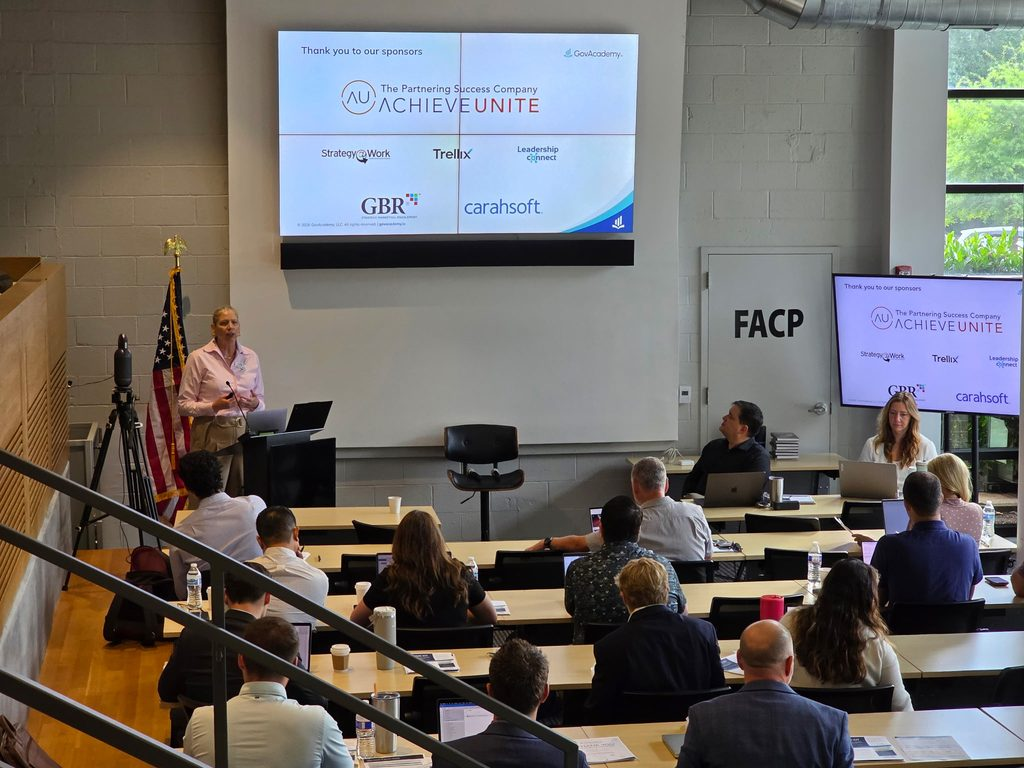
Juliana Slye, CEO & Founder of GBR & GovAcademy; Craig Bowman, SVP at Trellix & author of CRAFT; and Mika Cross, CEO of Strategy@Work, present at GovAcademy’s inaugural workshop: From Vendor to Trusted Advisor.
There are plenty of places to learn another sales methodology.
This wasn’t one of them.
When GovAcademy founder Juliana Slye set out to build From Vendor to Trusted Advisor, she wasn’t interested in creating another day of sales presentations. The idea was to give experienced B2G professionals a place to bring the accounts they were actually working on, work through real buyer challenges, and learn from people who know the government market from different sides of the table.
“I wanted this to feel different from the start,” said Slye.
“Too much B2G training stops at information,” she added. “I wanted to create a room where experienced professionals could bring the accounts they are actually working on, pressure-test how they’re thinking, and sharpen the strategy behind how they engage the buyer and move the opportunity forward.”
That idea shaped the day from the start.
At GovAcademy’s From Vendor to Trusted Advisor workshop, experienced GovCon and GovTech professionals walked into the room with something more useful than a hypothetical case study:
A real government account. A real buyer. A real opportunity they were trying to move forward.
And for a full day, that account became the work.
It was far from a traditional, passive training experience. No sitting through a marathon of monologues, no thumbing through printed slides. No generic list of sales tips to revisit someday.
Instead, throughout the day, attendees worked through how they read their buyers better, who and what else was influencing their accounts, what signals they might be missing, and how they approached discovery, trust, pain, and risk.
The point was not to leave knowing more.
It was to leave seeing their accounts differently.
And if you were not in the room, this is what you missed.
The sales pitch was not the starting point
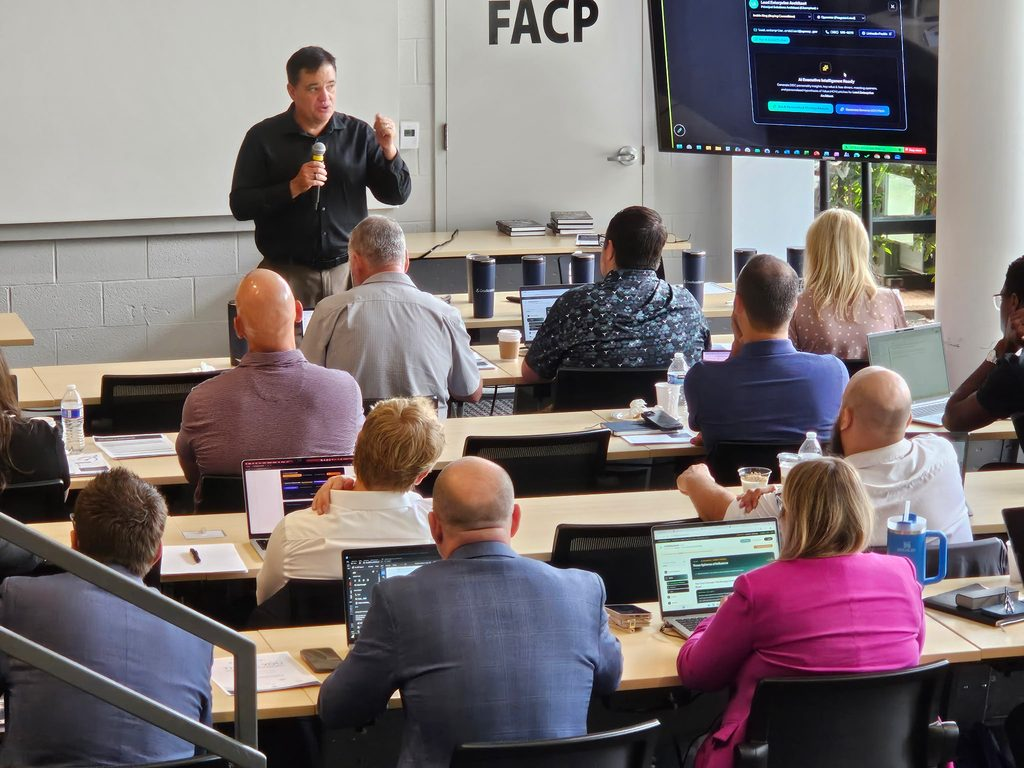
Craig Bowman, SVP at Trellix & author of CRAFT
One of the biggest shifts of the day happened before anyone got anywhere near a customer pitch.
Craig Bowman, SVP at Trellix and author of CRAFT: CIA Elite Selling, led attendees through CRAFT in three parts throughout the day. Attendees had exclusive access to the CRAFT Playbook and applied the framework directly to the real accounts they brought into the room, moving from targeting, signals, and account intelligence to activation, meeting control, pain, and proof.
Bowman also brought AI directly into the account-planning process through his exclusive CRAFT platform. Attendees entered the real accounts they were working on and used the tool to look at the opportunity in a whole new way: where the strategy was strong, where hidden gaps or flawed assumptions could put the opportunity at risk, and where a sharper read of the account could change the path forward.
The AI was designed as an extension of the CRAFT methodology itself, giving attendees a purpose-built way to uncover hidden information, test their account strategy, surface blind spots, and sharpen the opportunity in real time. It both surfaced and turned real-time account intelligence into something they could interrogate, challenge, and act on, exposing gaps in research, targeting, stakeholder dynamics, pain, and proof before those gaps showed up in front of the customer.
“CRAFT is not another sales process,” said Bowman. “It is a field-tested framework for operational discipline, adapted from CIA tradecraft. It provides the system to move with intent: measured, deliberate, and effective,” he said.
“It fills the critical gap where most deals fail: before you’re in front of the customer.”
The value was in the application. Attendees were not just learning a framework. They were pressure-testing what they knew about their accounts, where their assumptions might be weak, and how that intelligence should shape the next customer conversation.
“The CONDUCT RESEARCH, REFINE, and FIND PAIN parts of the presentation of CRAFT, I believe, will help dramatically in conversations with customers. This will help provide the necessary information to make sure the pitch that you are delivering to agencies/customers is on par with their mission.” Workshop Attendee
Let’s face it, a polished customer pitch only gets you so far. The stronger conversation starts with a better read of the account: what matters to the customer, where the pressure sits, and how what you’re selling connects to what they are actually trying to accomplish.
Humility may be one of the most important sales skills
One of the strongest ideas Bowman brought into the room was also one of the least conventional: humility.
“The most valuable parts of the day were CRAFT parts 2 and 3, and mainly the focus on how to bring more humility into the sales process.”Workshop Attendee
Bowman challenged a common instinct in sales: walking into the conversation ready to prove what you know.
In government, that can work against you. Buyers are operating with pressures, constraints, internal dynamics, and accountability that industry may not fully see.
For Bowman, humility meant leaving enough room to learn what you don’t know before deciding what the buyer needs.
Sometimes the stronger sales move is not having the answer. It is asking the better question. And to do that, you have to see things from the GovBuyer’s side of the table.
Government looks different from the buyer’s side of the table
Mika Cross, a federal workplace expert, Army veteran, former federal leader, and CEO of Strategy@Work, was instrumental in helping the room understand what that view looked like. She brought the room inside a federal workplace that has changed more dramatically than many sellers realize.
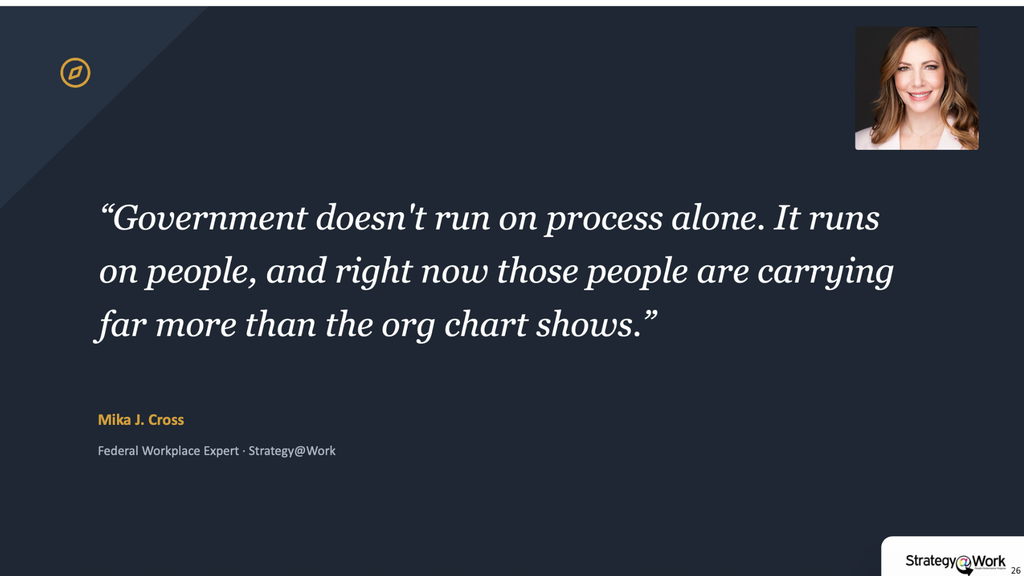
“Somewhere in your CRM is a name that no longer answers your emails or calls,” said Cross. “The message goes through, nothing comes back.”
“For them, everything has changed. It could be that their chair is now empty and never got refilled. Or that the work was absorbed by someone new, with less institutional memory, more oversight, and with real anxiety about their own job and their own future.”
Her session took an honest and open look at what has changed inside the federal workplace: who left, what those who stayed inherited, what they are carrying, and why familiar approaches to federal buyers may no longer work.
Cross grounded that conversation in the actual data of what is happening across the workforce itself, from shifts in staffing and institutional knowledge to changing workplace expectations, modernization pressure, engagement, and the growing demands on the people still carrying the mission.
The point was not to turn sellers into workforce experts. It was to help them understand the environment their buyers operate in before they ever start talking about a solution.
She helped the sellers understand that it wasn’t about what changed.
It was what those changes meant when you picked up the phone, walked into a meeting, or tried to earn the attention of a federal buyer whose world may look very different from what it did a few years ago.
“For me, the most valuable part of the day was hearing from Mika Cross. I enjoyed hearing some of the stats around how government has changed over the last decade. It also reminded me to be sure to consider the customer’s perspective going into conversation with them. However, the entire session was great, and it’s very beneficial for net new sales leaders.”Workshop Attendee
Knowing your message is one thing.
Knowing how it lands on the other side of the table is another.
The room itself became part of the curriculum
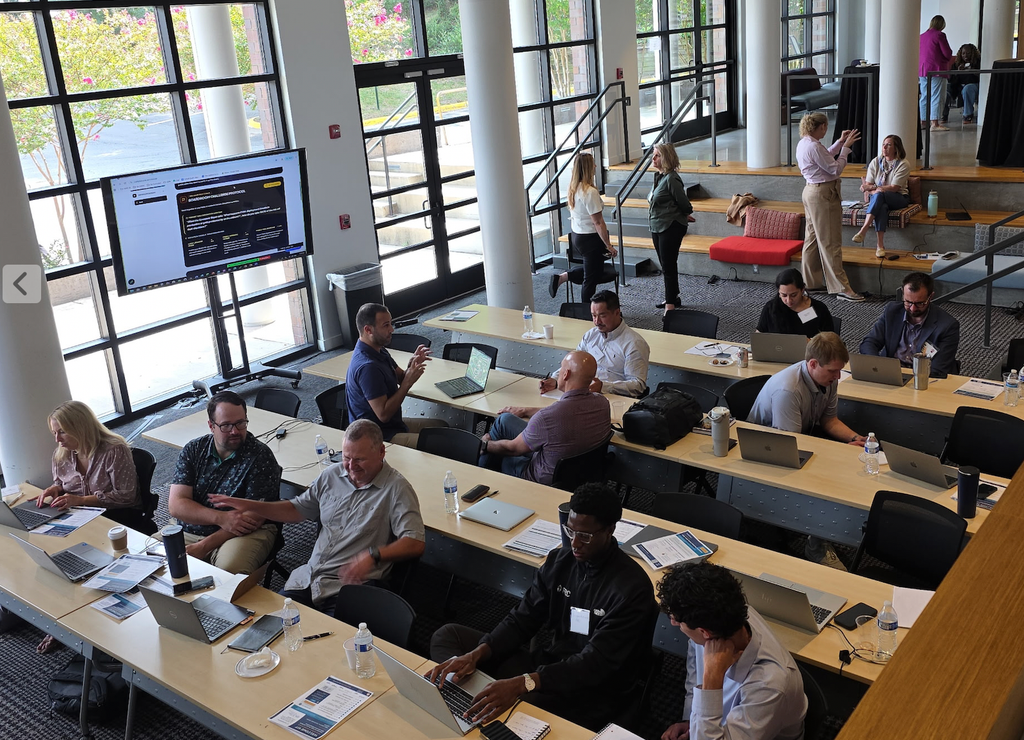
One of the most valuable parts of the day came from the conversations happening between attendees.
Because everyone brought a real account, the questions were specific. People compared how they were reading buyers, challenged each other’s assumptions, and talked through different ways to approach the opportunity in front of them.
When attendees were asked what they wanted more of, several pointed to those conversations and breakout discussions.
“I was a fan of the breakout groups and sharing different ideas with the group!”Workshop Attendee
“There were real-world examples and work you can walk away with. Group session lessons were valuable. Looking forward to diving into the book more.”Workshop Attendee
“The calibration against the people attending the class and hearing what other people’s customer targets were, and what the HOV was for their customer.”Workshop Attendee
“I think I would have enjoyed attending in person and hearing the conversations taking place between the others in the room when brainstorming on some of the activities.”Workshop Attendee
That is the part that is hardest to reproduce anywhere else. The value was not only in hearing how an instructor would approach the account. It was in having another experienced B2G professional at the table ask a question you hadn’t considered, notice something you had missed, or challenge how you were framing the buyer.
Being in the room created that kind of exchange in real time. Different backgrounds, different accounts, different experience levels, and different reads on the same kinds of problems made the work sharper.
You could arrive with one view of the account and leave with another because someone sitting a few feet away saw something you didn’t.
That is what made the room itself part of the workshop.
This is what “where B2G gathers” means
A workshop like From Vendor to Trusted Advisor is valuable, in part, because of what happened around the table.
Attendees of varying experience levels and account types were assigned to groups. From there, they openly and willingly shared advice on how someone else read an account, what they saw in the buyer, which assumptions got challenged, and how that changed the next move.
By the end of the day, each attendee left with a clearer way to think about the work in front of them.
And that was everything.
You can read the recap. You can see the photos. You can hear what people took away.
But you cannot fully recreate the moment when someone in the room says something that changes how you see your account, your buyer, or the conversation you were planning to have next.
That is the value of being in the room.
And it is exactly what GovAcademy intends to create more of.
“We created GovAcademy because the people doing this work need more than training content,” said Juliana Slye, founder of GovAcademy.
“They need access to experience, to each other, and to the kind of conversations that change how they go back and approach the work. That’s what happened in this room, and it’s exactly what we want to keep building.”
Don’t miss the next room. Join the GovAcademy community for upcoming workshops, conversations, and B2G learning opportunities.