

Currently Empty: $0.00
Sales
What Federal Funding Still Moves During a Shutdown (2/5)
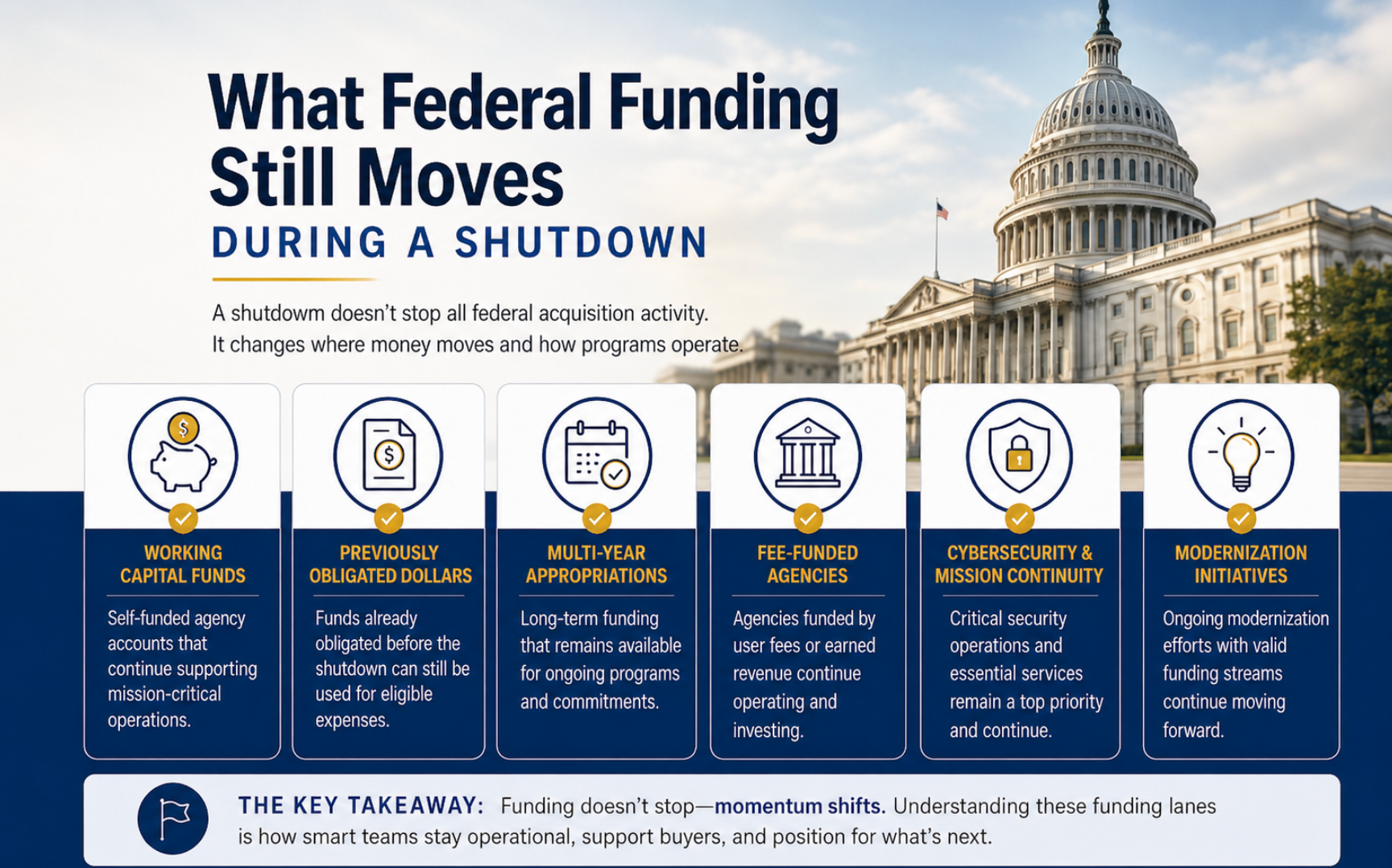
Image generated with AI
Part of the series: How GovCon and GovTech Teams Stay Relevant When the Market Slows
FEDERAL MARKET CONTINUITY PLAYBOOK
A shutdown doesn’t stop all federal acquisition activity. It changes where money moves and how programs operate.
This is the second article in a five-part series that explores how federal sellers, marketers, and leaders can stay visible, useful, and operationally aligned during periods of uncertainty without damaging trust or exhausting their teams. We’ll cover:
- How to Keep Moving Forward During a Federal Shutdown
- What to Do When the Federal Market Feels Frozen
- What Federal Funding Still Moves During a Shutdown
- Where to Focus Your Energy During a Shutdown
- How to Support Federal Buyers Without Sounding Opportunistic
- How to Prepare for the Federal Market Rebound
Long-term modernization initiatives, cybersecurity programs, working capital funds, fee-funded agencies, and previously obligated dollars often continue supporting mission-critical work even while new appropriations stall.
In this environment, operational awareness matters more than broad market optimism. Understanding which funding lanes remain active is one of the biggest differences between vendors who freeze and vendors who continue building relationships and pipeline.
Programs and funding that continues moving
Even during funding disruptions, several categories of federal activity frequently remain operational:
- Working capital funds
- Previously obligated dollars
- Multi-year appropriations
- Fee-funded agencies
- Mission-critical modernization initiatives
- Cybersecurity and continuity operations
The teams that recognize and understand these lanes can identify opportunities while competitors assume everything has stopped.
Why are some programs still funded during a shutdown?
During a federal government shutdown, programs that stay operational fall into two main categories: essential services required for the safety of human life or protection of property, and mandatory spending programs (or independently funded services) that do not rely on annual Congressional appropriations. This creates opportunities for vendors who understand operational pressure and know how to align their company’s solutions to active funding realities.
We’ve outlined a few of these relevant areas below, and given examples of the types of programs that may continue during a federal shutdown.
Mandatory Spending Programs
Programs governed by permanent laws—rather than annual budget bills—continue to operate without interruption.
- Social Security & Medicare: Benefit checks are processed and medical claims continue to be paid.
- Medicaid: Federal matching funds for state Medicaid programs generally continue, though administrative disruptions can sometimes occur.
- Veterans Affairs (VA) Benefits: VA medical centers, disability compensation, and pension payments continue.
Essential Public Safety & Defense
Agencies vital to national security and law enforcement are “excepted” from furloughs. Staff may be required to work without pay until a budget is passed.
- Military Operations: Active-duty military personnel, as well as Guard and Reservists on active-duty orders, continue to operate.
- Law Enforcement & Prisons: The Department of Justice (FBI, DEA, federal prisons) and border security operations (Customs and Border Protection, Immigration and Customs Enforcement) remain fully staffed.
- Air Travel & Security: Air traffic controllers, Transportation Security Administration (TSA) officers, and Coast Guard operations continue to protect national airspace and waterways.
Independently Funded & Revenue-Generating Operations
These programs have their own streams of funding (like user fees, excise taxes, or multi-year funds) and bypass the annual appropriations process.
- U.S. Postal Service (USPS): Mail delivery operates on a normal schedule because it is funded by the sale of stamps and shipping services, not tax revenue.
- The Federal Reserve & FDIC: Bank supervision and deposit insurance operations are funded by assessments and fees on financial institutions.
Limited Administration & Emergency Services
Some non-furloughed personnel remain on the job to process time-sensitive applications or maintain emergency capabilities.
- Federal Courts: The federal judiciary generally remains open for a limited period using fee balances and “excepted” personnel to handle essential proceedings.
- Tax Processing & Revenue Collection: The Internal Revenue Service (IRS) continues processing tax returns and collecting revenue, often supported by pre-existing funding streams.
- Disaster Relief: The Federal Emergency Management Agency (FEMA) continues to respond to ongoing disasters and emergencies using previously appropriated multi-year funds.
To understand how specific agency contingency plans impact services or to check operating statuses, consult the U.S. House of Representatives Government Shutdown Guide or review the Bipartisan Policy Center Shutdown Explainer for comprehensive breakdowns.
It is possible to plan ahead
Let’s face it, federal shutdowns don’t happen overnight, or in a vacuum. Often, we’re given months of notice. So the time to start considering where and how to shore up your pipeline is in the months ahead – June timeframe if you’re concerned about a September shut-down.
You can start at the beginning of your qualification process. Ask your prospect where the budget is coming from to fund their purchase, and whether those dollars are tied to ongoing programs or net-new programs – and what type. Ongoing programs are safer, especially those that align to the list above.
And, it’s worth keeping the list above in mind when you’re negotiating for territory. Ensuring that you have a diverse portfolio of customers and programs will help you weather a storm – either a shutdown or other significant events.