

Currently Empty: $0.00
Marketing
Is it Time to Shift Your Cyber Marketing Approach? (1/3)
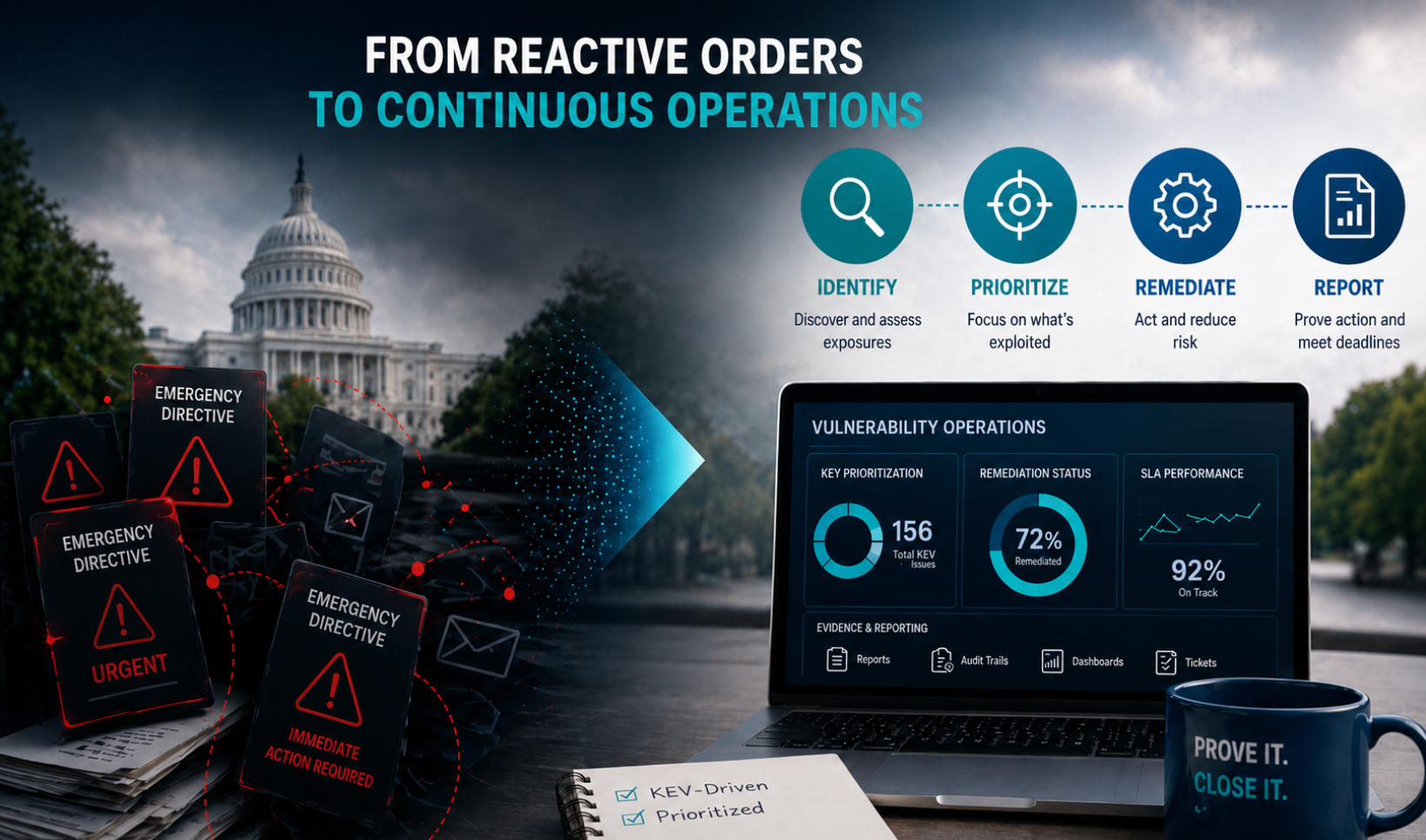
Image generated with AI
A three-part series that takes a closer look at federal cyber marketing in the age of continuous operations.
On January 8, 2026, CISA announced it was retiring ten Emergency Directives (EDs) issued between 2019 and 2024, saying the objectives have been completed or are now covered under broader ongoing requirements—most notably Binding Operational Directive (BOD) 22-01 and its Known Exploited Vulnerabilities (KEV) Catalog approach.
What does this mean for your marketing?
This is the first article in a three-part series that examines the shift in federal cyber policies, and how it impacts messaging, positioning and marketing. We’ll cover:
- Is it Time to Shift Your Cyber Marketing Approach?
- The New Federal Cybersecurity Vocabulary
- Marketing Content That Moves Federal Cyber Deals Forward
What happened (and why it matters to marketing)
CISA’s retirement of these EDs is unusual in scale: it closes out ten directives at once, spanning a wide range of high-profile incidents and vulnerabilities (DNS tampering, Windows/VMware, SolarWinds, Exchange, etc.). Multiple articles note CISA’s rationale: these EDs are “done” or now “redundant” because ongoing governance mechanisms cover the intent and the need.
The connective tissue is BOD 22-01, which requires Federal Civilian Executive Branch agencies to prioritize remediation around a curated, CISA-managed list of known exploited vulnerabilities (KEV) with deadlines for mitigation. It’s the operational backbone that turns “patch better” into measurable compliance, and CISA wants to spotlight it. So, what better way to spotlight it than to remove or retire those EDs that overlap?
Translation: the customer is shifting expectations
- The federal buyer mindset is shifting from event response to ongoing performance.
- They want vendors who help them execute the workflow (identify, prioritize, remediate, report) and produce audit-ready evidence along the way.
- They increasingly reward clarity: what gets better, how fast, with what proof, and what burden is removed.
For federal security teams, this is a milestone. But for vendors and B2G marketers, it’s a very specific signal: the market is moving away from “stop the headline” urgency messaging and toward repeatable operational outcomes: visibility, prioritization, remediation, and evidence. It shows that CISA’s posture is increasingly about building durable cyber resilience across agencies, with KEV-driven remediation as a core mechanism for focus and accountability.
Ok, so this is about CISA. But what about you? Well, if your messaging still leans heavily on incidents, executive orders or “AI-powered” buzzwords, you’ll likely get lost among a sea of other vendors saying the same thing. However, if you can align your story to how agencies are being pushed to operate (continuous vulnerability management with proof) – then you can stand out and accelerate pipeline.
Shifting from emergency orders to continuous operations
Emergency Directives are designed to force immediate action on urgent risks. Retiring them does not mean threats are lower. Instead, it means agencies are increasingly expected to manage cyber risk through standing requirements, operational discipline, and repeatable remediation processes — especially KEV-driven vulnerability management.
That emphasis shift changes how cybersecurity value is evaluated across the federal market. It’s moving away from reactive response and toward operational continuity, measurable remediation, and defensible proof. And this is the shift that matters.
Changes to federal cybersecurity value centers
The shift has a marked impact on how cybersecurity value is now judged:
- Past: Can you block everything?
- Now: Can you reduce exposure consistently over time?
- Past: Do you have the newest features?
- Now: Can you operationalize remediation, prioritize risk effectively, and close the loop?
- Past: Trust our platform.
- Now: Show us the artifacts, workflows, evidence, and reporting that prove the process works.
Where marketing can misfire
This is where cybersecurity marketing can begin to disconnect from how federal buyers actually operate. Many vendors publish awareness-level thought leadership focused on threat escalation, AI buzzwords, or broad “future of cyber” messaging. But federal buyers are trying to solve operational questions tied to remediation, auditability, and accountability.
Those federal infosec teams are asking:
- How do we prove remediation SLAs were met?
- How do we prioritize what is actively exploited right now?
- How do we document mitigation decisions?
- What evidence supports compliance and review processes?
- How do we operationalize this across environments consistently?
The vendors that stand out are the ones who help agencies answer those questions clearly, operationally, and with measurable proof. And, to do that, vendors must be communicating with the right vocabulary.